TiN, CrN, TiCrN, AlTiN, and AlCrN
A Detailed Engineering Comparison

This guide compares the five most common nitride coatings side by side to help engineers understand where each performs best.
Not all PVD nitride coatings are designed for the same environment.
While TiN, CrN, TiCrN, AlTiN, and AlCrN all improve wear resistance and extend component life, each coating has strengths and tradeoffs. Some excel in abrasive wear, others resist galling, and some are specifically designed for high-temperature oxidation.

This article compares five common nitride-based hard coatings:
TiN, CrN, TiCrN, AlTiN, and AlCrN
These coatings are all used to improve wear resistance, reduce galling, protect surfaces, and extend component life. However, they behave very differently in hot or corrosive or vacuum environments, as well as when there is sliding contact.
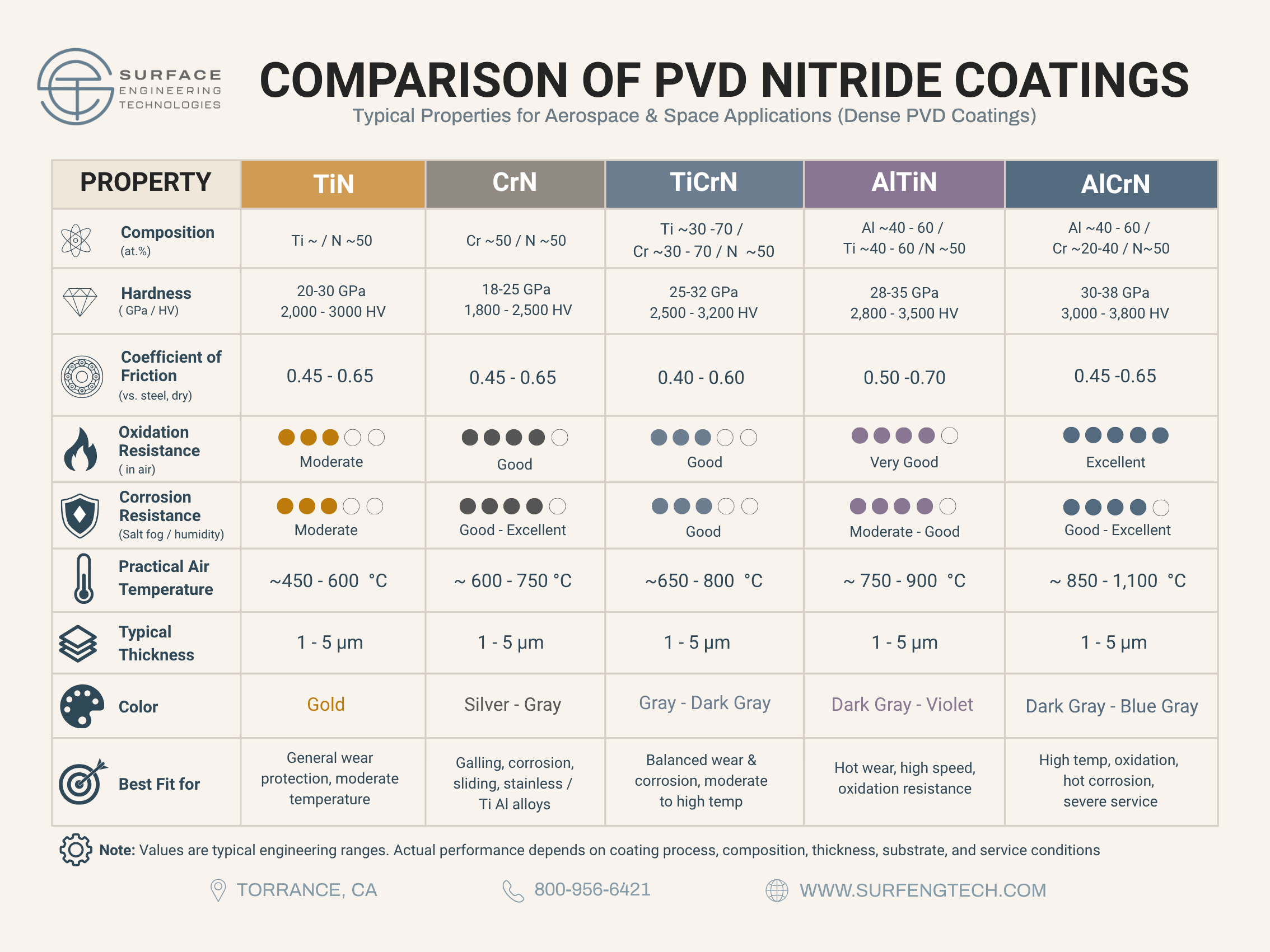
Quick Comparison
TiN
The Baseline Coating
Titanium Nitride, TiN, is the classic gold-colored PVD coating. It is widely used because it is proven, relatively economical, chemically stable, and available from almost every coating supplier.
| Property | Typical Range |
|---|---|
| Hardness | 20–30 GPa |
| Microhardness | 2,000–3,000 HV |
| Coefficient of friction vs. steel | 0.45–0.65 |
| Typical thickness | 1–5 µm |
| Practical air temperature range | ~450–600 °C |
| Color | Gold |
Where TiN works well
TiN is a good choice for general wear protection where temperature is moderate and the environment is not highly corrosive. It can be used on tools, pins, bushings, guides, fasteners, and general mechanical components.
In aerospace, TiN may be useful for:
Wear surfaces in moderate-temperature mechanisms
Assembly tools and production fixtures
Non-critical sliding contacts
Decorative or identification surfaces where gold color is useful
Components where heritage and supplier availability matter
Where TiN is weak
TiN is usually not the best choice when oxidation temperature is high. Above roughly 500–600°C in air, TiN can oxidize and lose performance. It also does not provide the same corrosion resistance as CrN or AlCrN.
Choose TiN when:
Cost and availability matter
Temperature is below ~500°C
The main problem is moderate abrasive wear
You need a known, low-risk baseline coating
Avoid TiN when:
The part sees high-temperature air exposure
Corrosion or salt exposure is important
Galling is the primary failure mode
Vacuum sliding is critical and untested
CrN
Better for Galling, Corrosion, and Tough Sliding
Chromium Nitride, CrN, is generally softer than TiN, AlTiN, and AlCrN, but it often performs better in sliding, galling, and corrosion-prone conditions. This is an important lesson: lower hardness does not always mean lower performance.
| Property | Typical Range |
|---|---|
| Hardness | 18–25 GPa |
| Microhardness | 1,800–2,500 HV |
| Coefficient of friction vs. steel | 0.45–0.65 |
| Typical thickness | 2–6 µm |
| Practical air temperature range | ~600–750 °C |
| Color | Silver–Gray |
Where CrN works well
CrN is often selected for components that experience adhesive wear, galling, corrosion, or sliding contact against stainless steel, aluminum alloys, or titanium alloys.
In aerospace, CrN may be useful for:
Actuator components
Bushings and sleeves
Valve components
Hydraulic and fuel-system components, depending on fluid compatibility
Stainless steel sliding interfaces
Components exposed to humidity or mild corrosion environments
Why CrN can outperform harder coatings
CrN often has good adhesion and toughness. In some applications, that matters more than peak hardness. A very hard coating that cracks or spalls early is worse than a slightly softer coating that stays attached.
Choose CrN when:
Galling or adhesive wear is the dominant problem
Corrosion resistance is important
The substrate is stainless steel or another corrosion-resistant alloy
You need a tougher coating with good adhesion
Avoid CrN when:
The part sees very high-temperature oxidation
Maximum abrasive wear resistance is the main requirement
You need the highest hot hardness
TiCrN
A Balanced Upgrade from TiN
Titanium Chromium Nitride, TiCrN, sits between TiN and CrN in behavior. It keeps much of the hardness of TiN-type coatings while adding some of the corrosion and oxidation benefits associated with chromium.
| Property | Typical Range |
|---|---|
| Hardness | 25–32 GPa |
| Microhardness | 2,500–3,200 HV |
| Coefficient of friction vs. steel | 0.40–0.60 |
| Typical thickness | 1–5 µm |
| Practical air temperature range | ~650–800 °C |
| Color | Gray to Dark Gray |
Where TiCrN works well
TiCrN is attractive when TiN is not enough, but AlTiN or AlCrN may be too thermally focused or too aggressive for the substrate/application.
In aerospace, TiCrN may be useful for:
Wear components needing better corrosion resistance than TiN
Hot-work tooling and production fixtures
Moderate-to-high-temperature sliding components
Components where both hardness and Cr-based chemistry are useful
Engineering Caution about TiCrN
TiCrN is composition-sensitive. A Ti-rich TiCrN coating will behave differently from a Cr-rich TiCrN coating. The Ti/Cr ratio affects hardness, residual stress, adhesion, oxidation behavior, and friction. For this reason, engineers should not specify only “TiCrN” and assume all suppliers will deliver the same performance.
A better specification should include:
Coating composition or target Ti/Cr ratio
Thickness range
Adhesion requirement
Hardness range
Surface roughness limit
Substrate preparation
Test method and acceptance criteria
Choose TiCrN when:
TiN is too limited
CrN is not hard enough
You need a balanced wear/corrosion coating
Moderate thermal resistance is required
Avoid TiCrN when:
You need the highest oxidation resistance
You need maximum space heritage
The supplier cannot control or report composition and process parameters
AlTiN
Strong Hot-Wear Performance
Aluminum Titanium Nitride, AlTiN, is designed for high-temperature wear. Its advantage comes from aluminum: during hot exposure, Al-containing nitride coatings can form protective aluminum oxide-rich surface layers that slow oxidation and heat transfer.
| Property | Typical Range |
|---|---|
| Hardness | 28–35 GPa |
| Microhardness | 2,800–3,500 HV |
| Coefficient of friction vs. steel | 0.50–0.70 |
| Typical thickness | 1–5 µm |
| Practical air temperature range | ~750–900 °C |
| Color | Dark Gray, Violet-Gray, Black-Gray |
Where AlTiN works well
AlTiN is a strong candidate for hot wear, especially where the contact sees frictional heating or repeated thermal exposure.
In aerospace, AlTiN may be useful for:
Hot forming and trimming tools
Machining tools for nickel alloys, stainless steels, and titanium alloys
Turbine-adjacent production tooling
Fixtures exposed to elevated temperature
Wear surfaces where oxidation resistance is more important than corrosion resistance
Important AlTiN Limitation
AlTiN is not automatically better because it contains more aluminum. Too much Al can destabilize the desired cubic nitride structure and promote softer wurtzite AlN. This can reduce mechanical performance. For many AlTiN coatings, composition and deposition energy are critical. Our AlTiCore coating can be designed for specific aerospace applications.
Choose AlTiN when:
The application is hot
Oxidation and hot wear dominate
The substrate can tolerate the coating stress
You need higher temperature capability than TiN, CrN, or TiCrN
Avoid AlTiN when:
Corrosion is more important than hot hardness
The part operates mostly at low temperature with galling risk
The supplier cannot verify phase stability, adhesion, and residual stress
Vacuum sliding is critical and no vacuum tribology testing has been performed
AlCrN
Best for High-Temperature Oxidation Resistance
Aluminum Chromium Nitride, AlCrN, combines aluminum’s oxidation resistance with chromium’s corrosion and thermal stability benefits. For high-temperature air exposure, AlCrN is often stronger than AlTiN.
| Property | Typical Range |
|---|---|
| Hardness | 30–38 GPa |
| Microhardness | 3,000–3,800 HV |
| Coefficient of friction vs. steel | 0.45–0.65 |
| Typical thickness | 1–5 µm |
| Practical air temperature range | ~850–1,100 °C |
| Color | Dark Gray to Blue-Gray |
Where AlCrN works well
AlCrN is often selected when temperature, oxidation, and wear are all severe. It is commonly considered for hot forming, die casting, high-temperature tooling, and components exposed to aggressive thermal cycles.
In aerospace, AlCrN may be useful for:
High-temperature tooling
Hot-section manufacturing fixtures
Components exposed to repeated thermal oxidation
Wear surfaces where TiN or CrN oxidize too quickly
Applications where Cr-based chemistry improves corrosion behavior
Why AlCrN is Attractive
Compared with TiN and CrN, AlCrN usually provides much better oxidation resistance. Compared with AlTiN, it often provides better oxidation resistance and corrosion behavior, especially at very high temperatures.
Engineering Caution about AlCrN
AlCrN can be hard and highly stressed. On sharp edges, thin sections, or fatigue-critical components, high coating stress can become a problem. Edge preparation, substrate hardness, coating thickness, and adhesion testing are very important.
Choose AlCrN when:
High-temperature oxidation is the leading concern
The part sees hot wear in air
You need better corrosion resistance than AlTiN
The substrate and geometry can support a hard, stressed coating
Avoid AlCrN when:
The part has very sharp edges that cannot be prepared
The substrate is too soft
The application is dominated by low-temperature galling, where CrN may be better
The coating supplier cannot demonstrate adhesion and thermal cycling performance
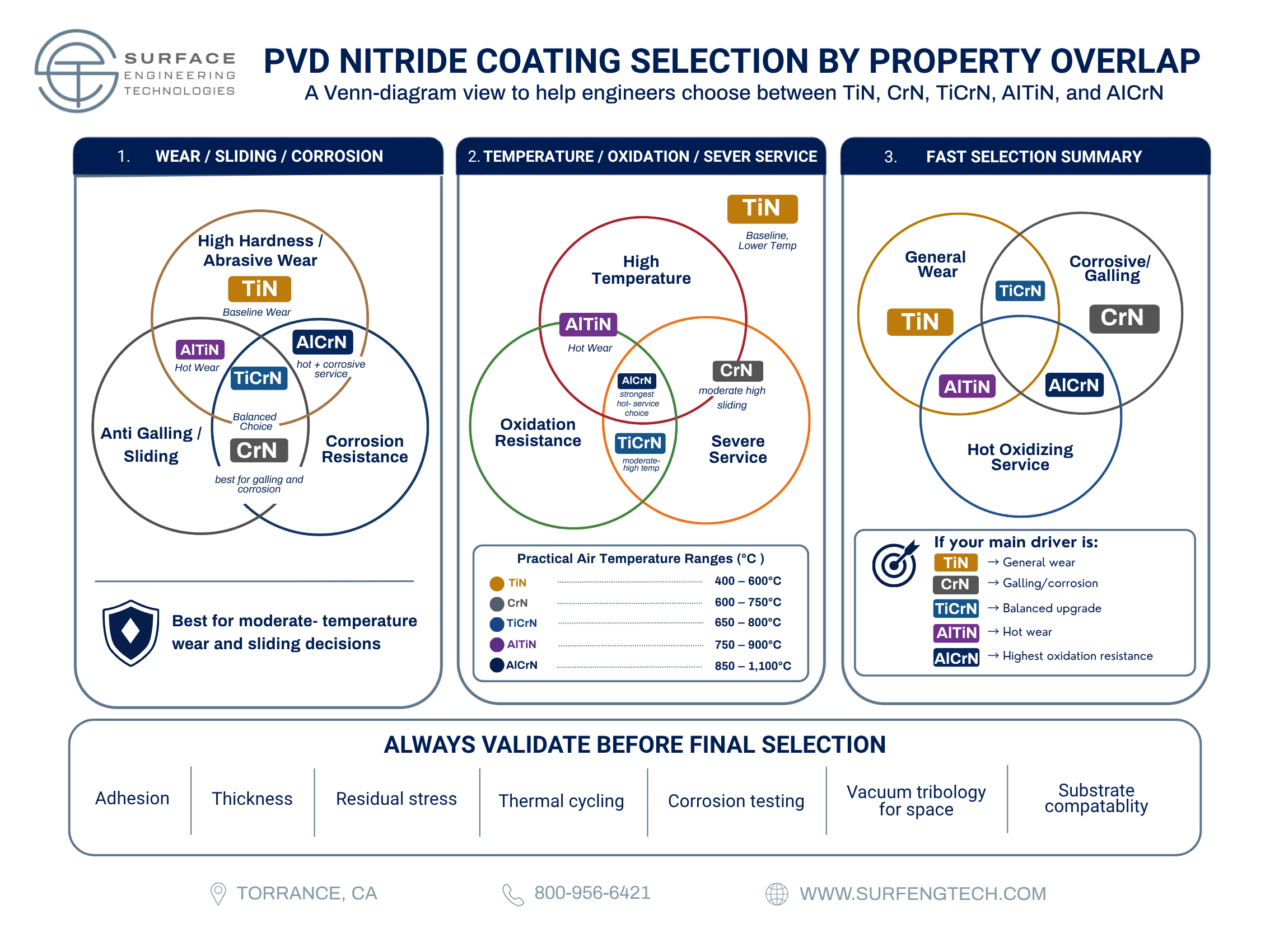
Practical Ranking by Engineering Priority
Best High-Temperature Oxidation Resistance
AlCrN
AlTiN
TiCrN
CrN
TiN
Best Low-Risk Baseline Coating
TiN
CrN
AlTiN
AlCrN
TiCrN
Highest Hardness
AlCrN
AlTiN
TiCrN
TiN
CrN
Best Galling and Corrosion Behavior
CrN
AlCrN
TiCrN
AlTiN
TiN
This ranking is not universal. It is a starting point for engineering discussion.
The numbers above are typical engineering ranges for dense PVD coatings. Actual values depend on deposition method, coating thickness, substrate, interlayer, surface preparation, bias voltage, composition, and post-treatment.
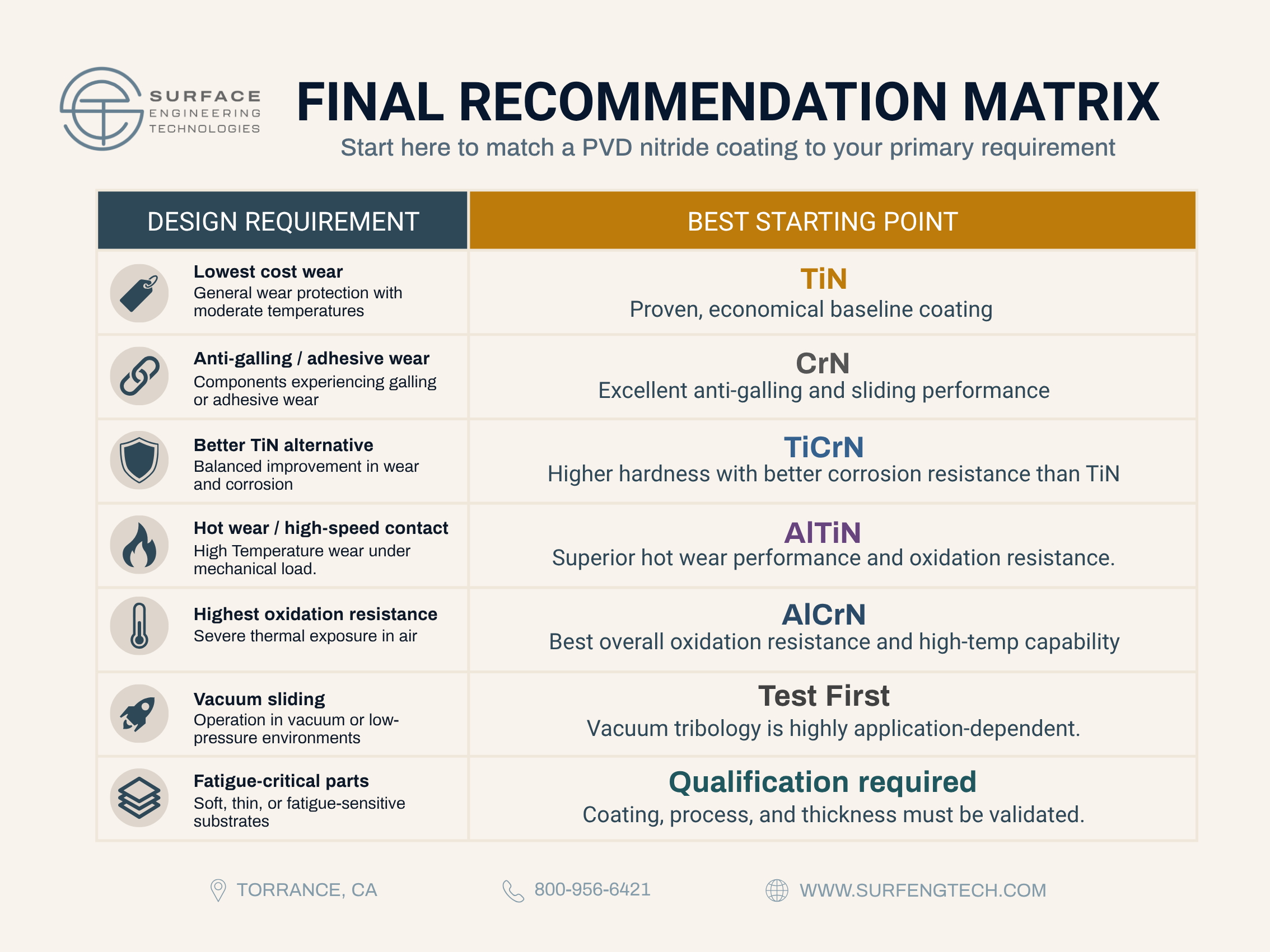
Final Thoughts
Every coating represents a tradeoff between hardness, toughness, oxidation resistance, corrosion resistance, friction behavior, and operating temperature.
If you want guidance understanding the tradeoffs, contact us for a free 15-minute consultation.