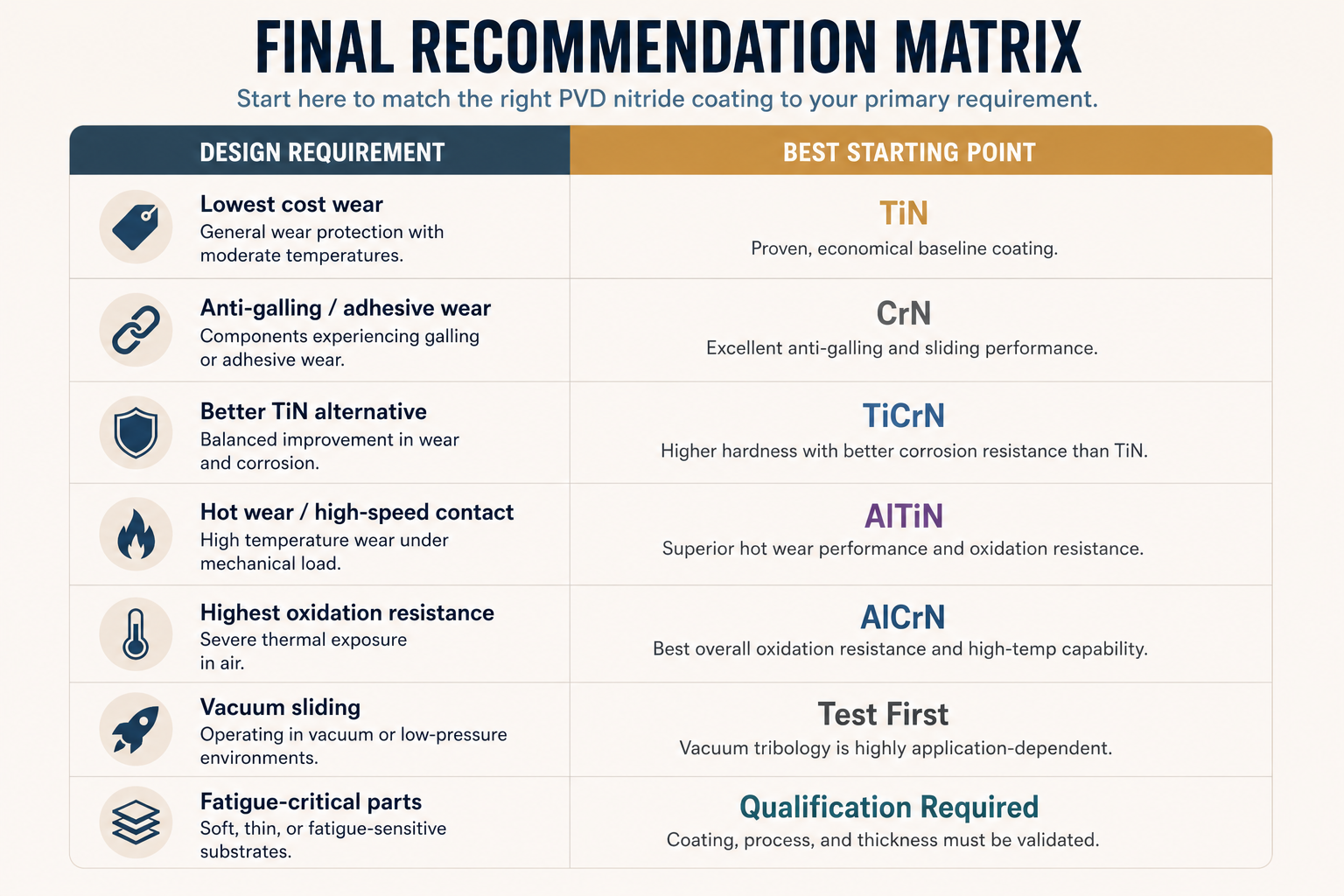
How to Write a Better PVD Coating Specification
Why Coating Selection Is Not the Same

Aerospace and space applications often involve many of the same materials, components, and wear mechanisms. But the operating environments are different enough that coating selection should not be approached the same way.

A coating that performs well on an aircraft component may behave differently in vacuum, during repeated thermal cycling, or in low Earth orbit. For space hardware, engineers must look evaluate vacuum friction, outgassing, atomic oxygen, and thermal stress in addition to hardness and oxidation resistance.
Aerospace Environments
Aerospace components may see:
High temperature
Oxidation
Fuel, hydraulic fluid, or lubricant exposure
Salt fog and humidity
Fretting
Vibration
Fatigue loading
Foreign object debris
Maintenance cycles
For many aerospace applications, the coating must survive a combination of wear, oxidation, corrosion, and fatigue.
This means the best coating is usually selected because of a combination of factors like hardness, adhesion, toughness, corrosion resistance, oxidation resistance, and compatibility with the substrate.
Space Environments
Space components may see:
High vacuum
Thermal cycling
Radiation
Atomic oxygen in low Earth orbit
No convective cooling
Cold welding risk
Lubricant evaporation or degradation
Contamination sensitivity for optics and sensors
For space applications, friction behavior in air may not predict friction behavior in a vacuum. Some coatings rely partly on tribo-oxide formation in air. In a vacuum, those oxides may not form the same way, so friction and wear behavior can change.
This is why vacuum tribology testing is important for space mechanisms.
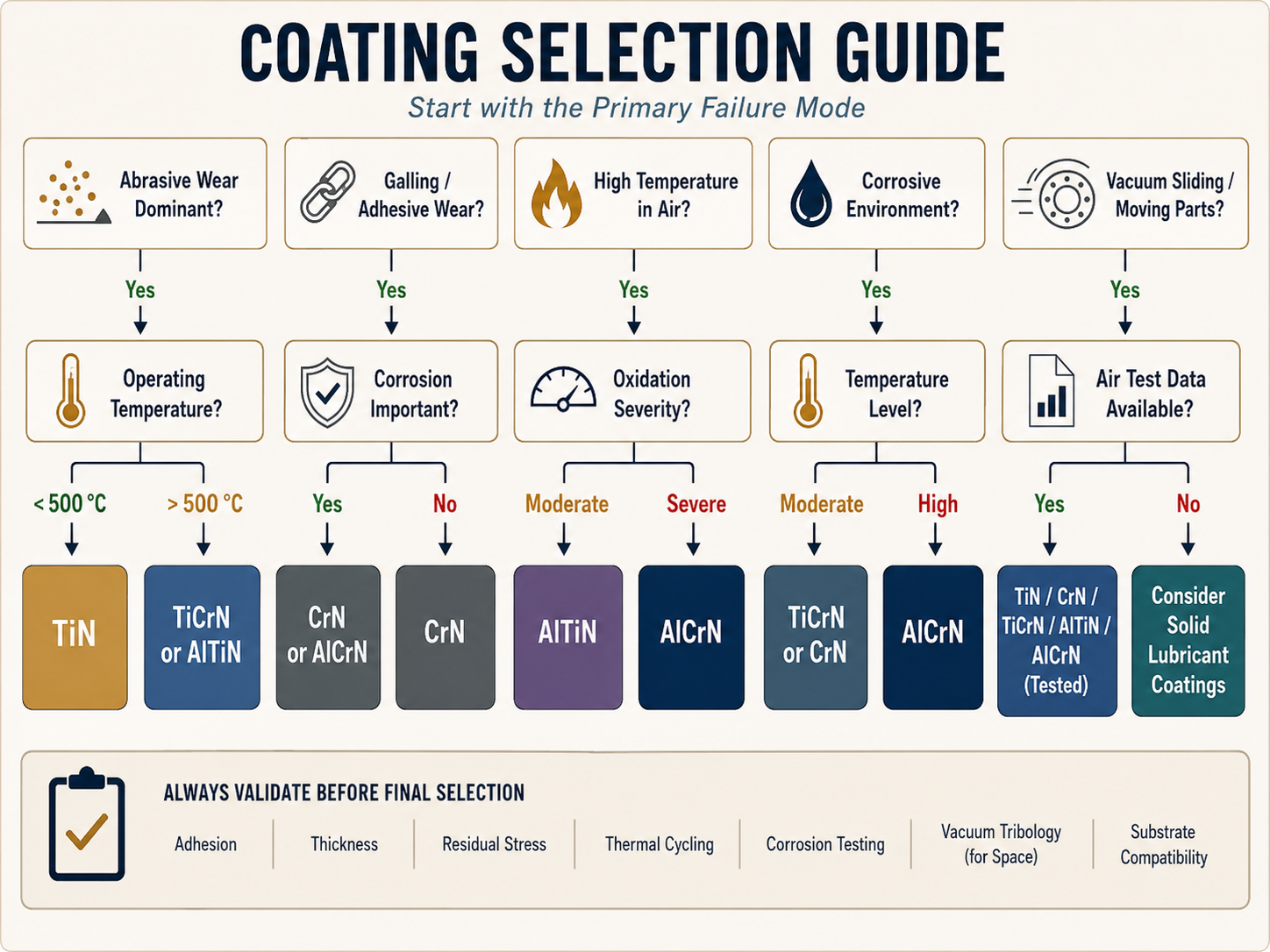
Special Space Considerations
Outgassing
Dense PVD nitride coatings such as TiN, CrN, TiCrN, AlTiN, and AlCrN are inorganic ceramic/metallic films and are usually not the main outgassing concern. However, the complete coated part still needs review.
Potential outgassing sources include:
Cleaning residues
Masking residues
Adhesives
Polymers
Lubricants
Porous coatings
Trapped contamination
Post-coating handling contamination
For space use, review ASTM E595 data where applicable. A common screening target is:
TML < 1.0%
CVCM < 0.10%
Even if the coating itself is acceptable, the full part process must be controlled.
Vacuum Friction
Nitrides are hard coatings, not solid lubricants. In vacuum sliding applications, they may need to be paired with a true space lubricant or solid-lubricant coating such as MoS₂, WS₂, or certain qualified dry-film lubricants.
For moving space mechanisms, do not choose TiN, CrN, TiCrN, AlTiN, or AlCrN based only on hardness. Require vacuum tribology data.
Atomic Oxygen
In low Earth orbit, atomic oxygen can attack many materials. Ceramic nitrides are generally more resistant than polymers, but coating defects, pinholes, and exposed substrate areas matter. If atomic oxygen is a design driver, the coating must be tested or supported by heritage data.
Thermal Cycling
A coating and substrate expand differently. This creates thermal stress during cycling. For space hardware, check:
Coefficient of thermal expansion mismatch
Coating thickness
Residual stress
Edge condition
Adhesion after cycling
Crack formation after thermal shock
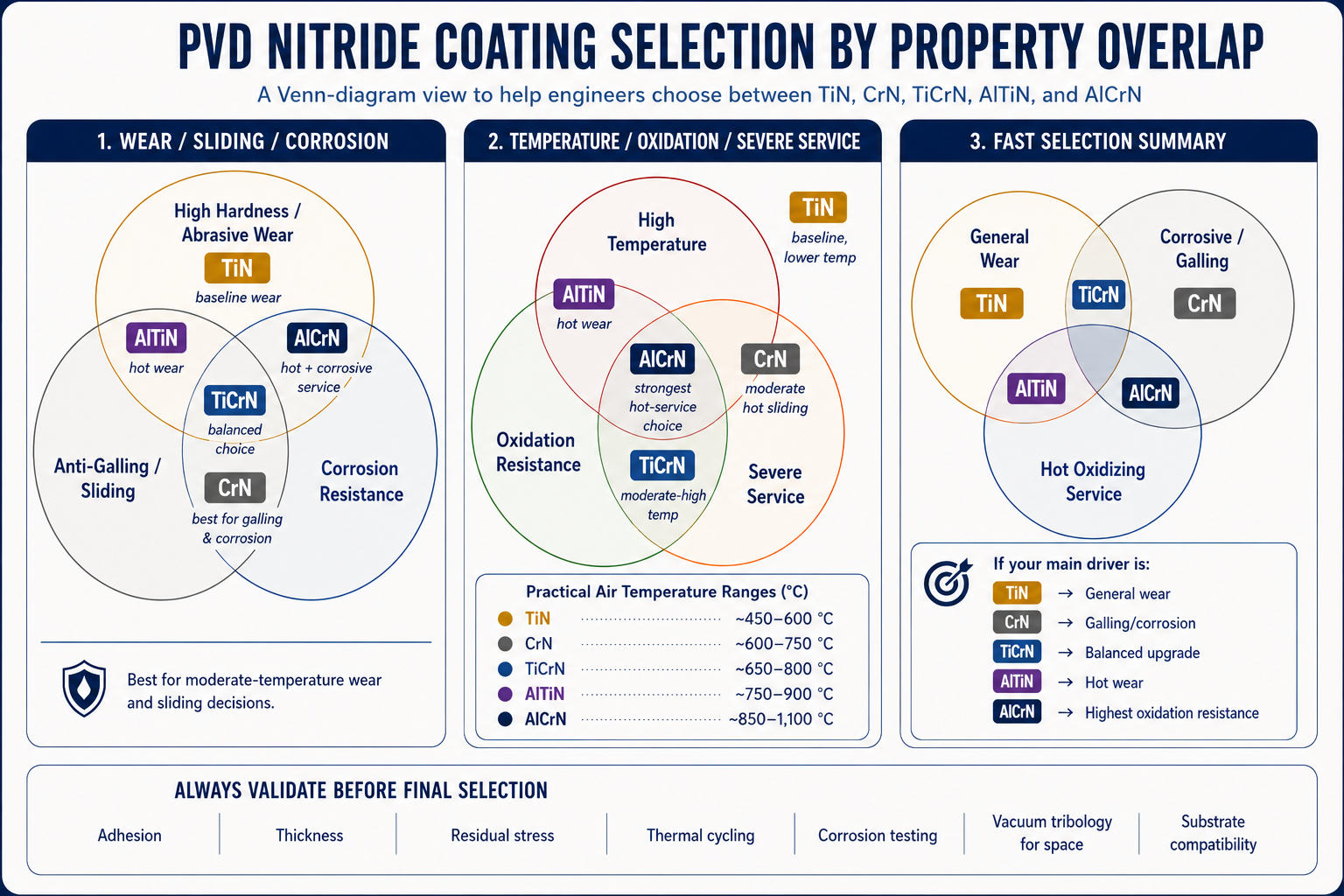
The Engineering Takeaway
Aerospace and space hardware may use many of the same PVD coatings, but they do not present the same qualification problem.
For aerospace components, the primary challenge may be balancing wear, oxidation, corrosion, fatigue, vibration, and fluid exposure. For space components, vacuum friction, contamination, atomic oxygen, lubricant compatibility, and thermal cycling may become the dominant concerns.
Select and test components for the environment in which the component will actually operate.